
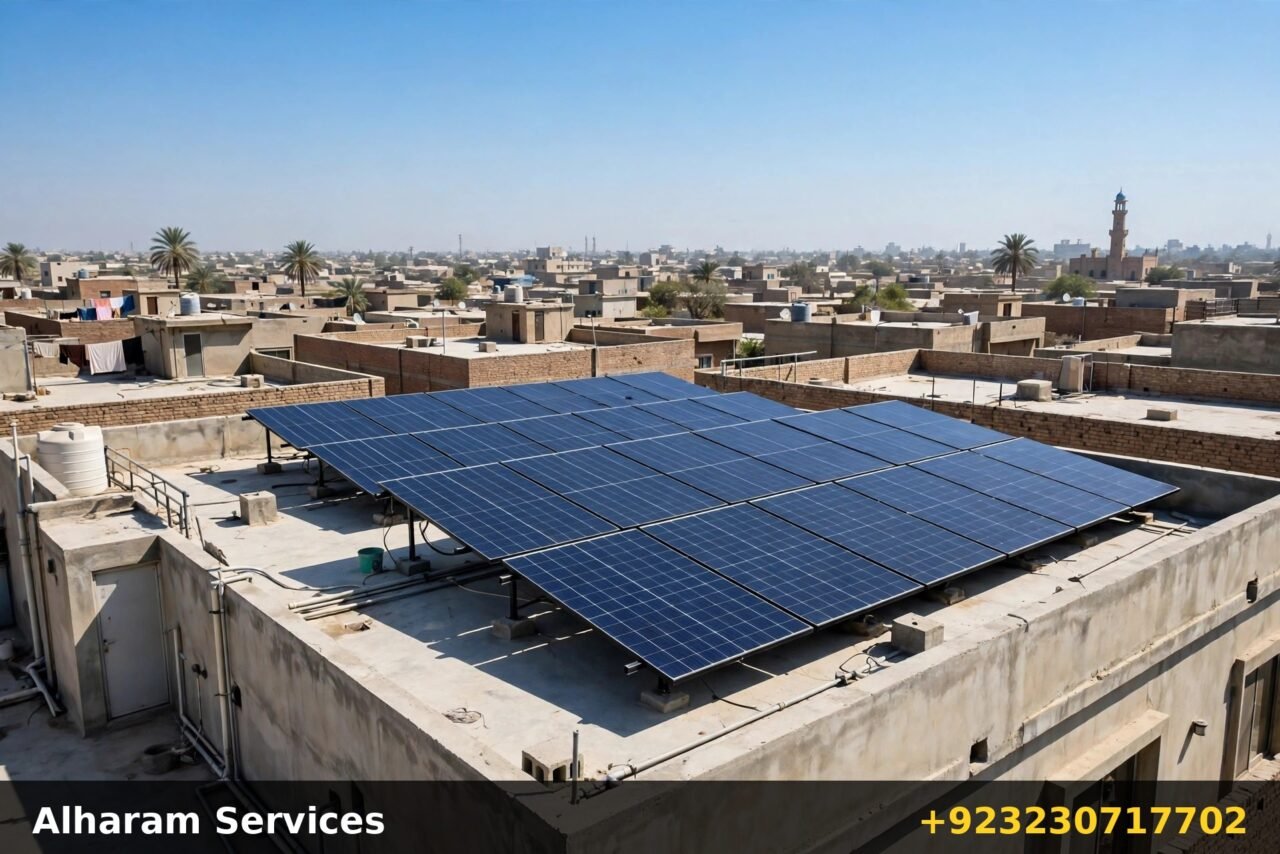

Electricity bills in Multan keep climbing, the summer heat keeps getting harder to bear, and load shedding still interrupts the hottest afternoons of the year. For a growing number of homeowners, the answer is on the roof. A proper solar panel installation in Multan turns the city’s fierce sun — the same sun that pushes temperatures past 45°C — into free electricity for your fans, lights, fridge and air conditioner. This guide explains everything a homeowner needs to know before installing solar: how much system you need, which panels and inverters to choose, how net metering works with MEPCO, what to check on your roof, and how to pick an installer you can trust. No inflated promises and no invented prices — only the factors that actually decide whether solar is right for your home.
Alharam Services provides complete electrician services in Multan, including solar panel installation, home wiring, inverter fitting and load management. Our team works across DHA Multan, Citi Housing, Buch Villas, Royal Orchard, Bosan Road, Gulgasht, Model City, MDA Officers Colony and Wapda Town. For a free roof survey and a written estimate, call 03230717702 or visit our contact page.
How Solar Panel Installation in Multan Works
A home solar system has four main parts. The solar panels on the roof convert sunlight into direct current (DC) electricity. The inverter converts that DC into the alternating current (AC) your home appliances use. The mounting structure holds the panels at the right angle, and the wiring, breakers and earthing connect everything safely to your home and, if you choose, to the grid. If you add batteries, they store extra daytime energy for use at night or during load shedding.
On a normal sunny day in Multan, the panels produce power from morning until late afternoon, with the strongest output around midday. The inverter feeds that power straight into your home’s wiring, so your appliances use solar electricity first and draw from the grid only when the sun is not enough. With net metering, any extra units you produce are exported to the grid and counted against your bill. The whole system is automatic — there is nothing to switch on or off each day, and a monitoring app or display shows how much your panels are producing.
Why Multan Is One of the Best Cities in Pakistan for Solar
Multan gets long, intense sunshine for most of the year. The city sits in southern Punjab, far from the cloud and rain that limit solar output in the north, and it enjoys clear skies through the long summer. A panel that would produce a modest amount in a cloudy city produces far more here, simply because the sun is stronger and out for longer. That is why solar pays back faster in Multan than in most other Pakistani cities.
The second reason is the load. Multan homes run fans and air conditioners for most of the year, and those are exactly the appliances that drive electricity bills up. Solar produces its maximum output in the same hot hours when your air conditioner is working hardest, so the timing matches perfectly: the sun is strongest when you need the cooling most. A home that spends heavily on summer electricity is usually the home that benefits most from solar.
How Much Solar Do You Need? System Sizes Explained
System size is measured in kilowatts (kW). A 3kW system suits a small house with fans, lights, a fridge and a television. A 5kW system is the most common choice for a normal family home — it can run fans, lights, a fridge, a washing machine and one inverter air conditioner during the day. A 10kW system suits a larger house with two air conditioners, a water pump and heavier daytime use. The right size depends on your monthly electricity units, not on the size of your roof alone.
The simplest way to size a system is to look at your last few electricity bills. Add up the units you use in a month, and check how many of those units you use during the day, when the sun is shining. A good installer will do this calculation with you and size the system to cover your daytime load first, because daytime units are the ones solar replaces directly. Oversizing a system without net metering wastes money, because extra daytime power has nowhere to go; undersizing it leaves you buying expensive grid units you could have generated yourself.
| System size | Panels needed (approx.) | What it can typically run in the daytime |
|---|---|---|
| 3kW | 5–6 panels | Fans, lights, fridge, TV, washing machine |
| 5kW | 9–10 panels | Above plus one inverter AC and water pump |
| 10kW | 18–20 panels | Above plus a second AC and heavier daytime loads |
Panel counts are approximate because a single modern panel is usually rated at 540 watts or more — fewer, stronger panels cover the same capacity as many older, weaker ones. Your installer should confirm the exact panel wattage and count in the written quotation before work begins.
Types of Solar Panels: Mono, Poly and Bifacial
Most panels sold in Multan today are monocrystalline, usually called mono panels. They are made from a single silicon crystal, which makes them more efficient — they produce more power from the same roof area — and they perform better in high heat than the older polycrystalline (poly) panels. In a city where roof space is limited and the sun is strong, mono panels are the sensible default, and almost every new installation in Multan uses them now.
Poly panels are cheaper per watt but need more roof space for the same output, and they lose more efficiency as the temperature climbs. They are still sold, but for a Multan rooftop the small saving is rarely worth the lost output. Bifacial panels are a newer option: they collect light from both faces, using sunlight reflected off a light-coloured roof surface as well as direct sun. They work best on an elevated structure over a white or light roof, and they can add useful extra output in the right setup. For most homes, a good-quality mono panel from a known brand, with a proper warranty, is the right choice.
Whatever the type, check three things on the panel itself: the wattage rating, the warranty (a 25-year performance warranty is the industry standard for quality panels), and the brand’s local presence. A panel with no service backup in Pakistan is a risk, because a warranty you cannot claim is worth nothing.
On-Grid, Off-Grid and Hybrid Systems — Which One Fits Your Home?
An on-grid system connects to the MEPCO grid and has no batteries. It is the cheapest option, it works with net metering, and it is the right choice if your main goal is a lower bill and your area has stable supply. Its one limitation is that it shuts down during a power outage — a safety rule, so that it never feeds electricity into a grid that line workers may be repairing.
An off-grid system has batteries and no grid connection. It suits a house or farmhouse with no reliable grid supply, but it costs more and the batteries need replacing after some years. A hybrid system is the middle path and the most popular choice in Multan: it connects to the grid, supports net metering, and keeps batteries for load shedding. During the day it runs your home on solar, exports the extra units, and during an outage it switches to battery power automatically. If load shedding is your main frustration, a hybrid system with enough battery backup is worth the extra cost.
Net Metering in Multan: Sell Extra Units Back to the Grid
Net metering is the arrangement that lets your electricity meter run in both directions. When your panels produce more than your home is using, the extra units go to the grid and your meter records them as exported units. At the end of the billing period, your exported units are subtracted from the units you imported, and you pay only for the difference. In Multan, net metering is handled through MEPCO, your local distribution company, and it generally needs a three-phase connection and a bidirectional (import/export) meter fitted by the company.
The application involves a form, your recent bills, the system’s technical details and an inspection before the new meter is installed. A professional installer should handle the paperwork with you — it is part of the job, not an extra you should be left to figure out alone. Net metering makes the most sense when your panels regularly produce more than your daytime use, which is common in Multan’s long sunny days. Without it, extra daytime power is simply wasted, so ask your installer to include the net metering application in the plan from the start.
Roof Checks Before Installation
Not every roof is ready for solar, and a ten-minute survey before installation saves years of trouble. The first check is space and shade: count the clear, unshaded area, and remember that a water tank, a stair room, a neighbour’s wall or a tall tree can shade part of the roof for hours each day. Even partial shade on one panel can cut the output of a whole string, so the layout must avoid shaded spots or use optimisers where shade cannot be avoided.
The second check is structure. A concrete flat roof — the most common roof in Multan — is ideal, because the mounting structure can be bolted or ballasted firmly. A steel-sheet roof needs special clamps and careful sealing so the roof does not leak. A tiled or sloped roof needs rails fixed to the rafters, not just to the tiles. The third check is access: the installer needs room to carry panels up, and you need room to walk between rows later to clean them. Finally, check the roof’s condition. If the roof needs waterproofing or repair, do that first — lifting a full solar array to fix a leak underneath is expensive and avoidable. Read our home maintenance guide for Multan for the seasonal roof checks that protect both the roof and the panels on it.
| Roof type | Suitability for solar | What to check first |
|---|---|---|
| Concrete flat roof | Best — strong, easy to fix, easy to clean | Waterproofing, shade from stair room and tanks |
| Steel-sheet roof | Good with proper clamps | Leak-proof sealing at every fixing point |
| Tiled or sloped roof | Good, needs rafter fixing | Tile condition and rafter strength |
| Roof with water tanks | Workable with planning | Relocate tanks or plan layout around their shade |
What a Professional Installation Includes, Step by Step
A professional installation follows a clear order. First comes the site survey: measuring the roof, checking shade through the day, inspecting the distribution board and the earthing, and confirming the system size against your bills. Then the structure is built — galvanised steel or aluminium frames, bolted or ballasted, set at the right tilt (roughly equal to Multan’s latitude, about 30 degrees, facing true south) so the panels catch the most sun through the year.
Next the panels are mounted and wired in strings, with DC cables run in proper conduit and labelled at both ends. The inverter is fitted in a shaded, ventilated spot — never in direct sun on a hot wall, because heat cuts its life — and connected to the distribution board through its own breaker. Earthing and lightning protection are fitted, the system is tested string by string, and the monitoring app is set up so you can see daily production on your phone. A good installer walks you through the readings, shows you the breaker positions, and leaves a written record of the panel and inverter serial numbers.
Inverters, Batteries and Wiring: The Parts People Forget
Homeowners compare panels carefully and then forget the inverter — but the inverter is the heart of the system, and it works harder than any other part. A string inverter handles the whole array and suits a roof with no shade. A hybrid inverter adds battery support and load-shedding backup. Whatever the type, it should be a known brand with local service, sized to match the panel capacity, and installed where it stays cool and dry.
Batteries matter only if you choose a hybrid or off-grid system. Lithium batteries last longer, charge faster and need almost no maintenance, but they cost more. Tubular lead-acid batteries are cheaper and widely available in Multan, but they need topping up, ventilation and replacement sooner. The choice depends on how many hours of backup you actually need — size the battery for your real night load (fans, lights, a fridge), not for the whole house.
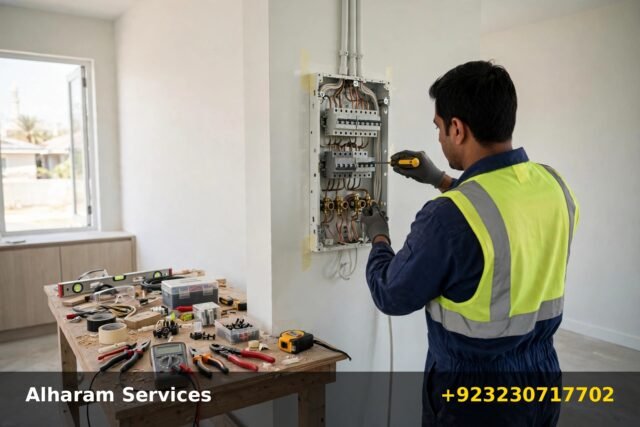
Wiring is where cheap installations fail. DC cables must be proper solar cable, not ordinary house wire; the runs must be in conduit, protected from sun and rats; every string needs its own breaker and surge protection; and the earthing must be tested, not just assumed. Bad wiring is also a fire risk, which is why this part of the job must never be left to an untrained helper. If your home’s wiring is old, read our electrician services guide for Multan first — a solar system on weak wiring is a problem waiting to happen, and our electrician team can check and upgrade the distribution board as part of the job.
Cost Factors: What Decides the Price of a Solar System
There is no single price for solar in Multan, because the cost depends on choices you make. The biggest factor is system size: a 10kW system needs roughly twice the panels, structure and inverter capacity of a 5kW system. The second factor is panel and inverter brand — a known brand with a real warranty costs more than an unbranded panel, and the difference shows up over twenty years of output, not on the day of installation.
The third factor is the structure. A simple low frame on a flat concrete roof costs less than an elevated structure built high enough to use the shaded space underneath, and a structure that must resist Multan’s summer dust storms needs stronger steel. Batteries are the fourth factor: a hybrid system with lithium batteries costs noticeably more than an on-grid system with none. Finally, the roof itself matters — a roof that needs waterproofing, a long cable run to the distribution board, or a net metering application all add to the total. Any installer who quotes a price without visiting your roof is guessing. Ask for a written quotation that lists the panel brand and wattage, the inverter brand and size, the structure type, the cable and protection items, and the net metering work — then compare quotations item by item, not by the final number alone.
Maintenance: Cleaning, Monitoring and What to Check Every Month
Solar panels in Multan need regular cleaning, because dust is the enemy of output. A dusty panel can lose a noticeable share of its production, and Multan’s dry, dusty air coats a roof quickly. In the dusty months, clean the panels every one to two weeks with clean water and a soft cloth or brush — early in the morning, when the panels are cool, and never with harsh chemicals or a hard brush that scratches the glass. Never walk on the panels, and never clean them in the midday heat, when cold water on hot glass can crack it.
Once a month, check the monitoring app for daily production and compare it with the previous month. A sudden drop usually means dust, a shaded panel, or a loose connection — all easy fixes if caught early. Also check the inverter display for error codes, look at the structure bolts after a dust storm, and keep the area around the inverter clear so it can ventilate. If your system stops producing or the inverter shows a fault, switch it off at the breaker and call your installer — do not open the inverter or touch DC wiring yourself. For a wider seasonal routine, our home maintenance checklist for Multan covers the roof, wiring and water checks that keep a solar home safe through the year.
Common Mistakes to Avoid When Installing Solar Panels
The most common mistake is buying on price alone. The cheapest quotation usually hides thinner structure steel, unbranded panels, undersized cables or no earthing — and each of those shows up as a failure within a year or two. The second mistake is skipping the shade survey: panels fitted behind a water tank or under a neighbour’s wall produce far less than promised, and moving them later costs more than planning properly.
The third mistake is ignoring the inverter’s location. An inverter baking in direct sun on a west-facing wall will overheat, shut down on hot afternoons — exactly when you need it most — and fail years early. The fourth is skipping net metering: without it, a system sized for your daytime load wastes its midday surplus. The fifth is forgetting the paperwork: no warranty cards, no serial numbers recorded, no written quotation, and no one to call when something stops working. A professional installer gives you all of these on the day of handover.
Choosing a Solar Installer in Multan You Can Trust
Choose an installer the way you would choose a builder for your house — on track record, not on a single low price. Ask for two or three recent installations in Multan that you can see or call, and ask how long the company has been doing solar work. Check that the quotation names the panel brand, wattage and warranty, the inverter brand and size, the structure material, and the protection devices — a quotation that lists only a total price tells you nothing.
Ask who does the net metering application, who cleans and maintains the system afterwards, and what the after-sales response time is. A company that disappears after payment is the most expensive installer of all. Alharam Services installs solar systems across Multan with a written quotation, named brands, proper earthing and protection, net metering support and after-sales service — and our construction team can handle any roof repair or structure work the installation needs. If you are building a new house, read our house construction cost guide for Multan first, so the solar structure and wiring are planned into the build instead of added as an afterthought.
2026 Update: Winter Solar Care in Multan — Short Days, Dust and Battery Health
Winter in Multan brings shorter days, morning fog and dust, so a solar system produces less than it does in June — but it still covers a large share of daytime use. The two things that matter most in winter are panel cleanliness and honest expectations: dust and smog film build up faster in the dry months, and a simple rinse every two to three weeks keeps output steady. A clean panel on a clear winter day still runs fans, lights, the fridge and daytime loads without trouble, and your electrician services in Multan team can check the wiring at the same visit.
Batteries deserve extra attention on cold mornings. Lead-acid batteries lose usable capacity when cold and should not be drained deeply, while lithium batteries handle winter far better but still need a dry, ventilated spot away from damp. Before winter, ask your installer to check battery water levels for flooded batteries, terminal tightness and inverter settings — a ten-minute check now prevents a dead system on the coldest morning. If you are planning a new system, size it for winter sun, not summer sun: a system that feels generous in June is the right size for December. A yearly home maintenance Multan visit is a good time to bundle the panel clean, the battery check and the aluminium and glass seals on your roof room windows.
Frequently Asked Questions
How many solar panels do I need for a house in Multan?
It depends on your daytime electricity use. A small house usually needs 5–6 panels (about 3kW), a normal family home needs 9–10 panels (about 5kW), and a larger house with two air conditioners needs 18–20 panels (about 10kW). The exact number comes from your recent electricity bills and a roof survey — ask your installer to show the calculation before you agree to a size.
Can solar panels work during load shedding in Multan?
Yes, but only with the right system. A plain on-grid system shuts down during an outage for safety. A hybrid system with batteries keeps running during load shedding and powers your essential load — fans, lights and a fridge — automatically. If backup during outages matters to you, choose a hybrid system and size the battery for the load you actually need at night.
How long do solar panels last in Multan’s heat and dust?
Quality panels carry a 25-year performance warranty and commonly keep working well beyond that, losing output only very slowly each year. Heat and dust reduce daily output — dust is fixed by regular cleaning — but they do not shorten the panel’s life the way a bad installation does. The inverter usually needs replacing once during the panels’ lifetime, so budget for that as normal maintenance.
Do I need net metering for my solar system?
You need it if your panels often produce more than your home uses during the day, which is common in Multan. Net metering lets the extra units count against your bill through MEPCO, using a bidirectional meter. Without it, surplus daytime power is wasted. A three-phase connection is generally required, and your installer should include the application in the installation plan.
How often should solar panels be cleaned in Multan?
In Multan’s dusty months, clean them every one to two weeks with clean water and a soft cloth, early in the morning when the panels are cool. After a dust storm, clean them the next morning. A clean panel produces noticeably more than a dusty one, so regular cleaning is the cheapest way to protect your output.
Do solar panels still work well during Multan winters?
Yes — panels still generate good power on clear winter days, typically enough for daytime loads, though total daily output drops because days are shorter and fog or dust can cut the light. Keep panels clean, trim shade from winter sun angles, and check batteries before the cold sets in. For a winter check of your system, contact Alharam Services.
Related Articles
- Electrician Services in Multan: Complete Guide to Wiring, Repairs & Safety
- House Construction Cost in Multan 2026: Complete Guide
- Home Maintenance in Multan: Seasonal Checklist to Protect Your House
Ready to cut your electricity bill with solar? Call Alharam Services on 03230717702 or visit our contact page for a free roof survey and a written solar quotation for your home in Multan.


Leave a Reply