
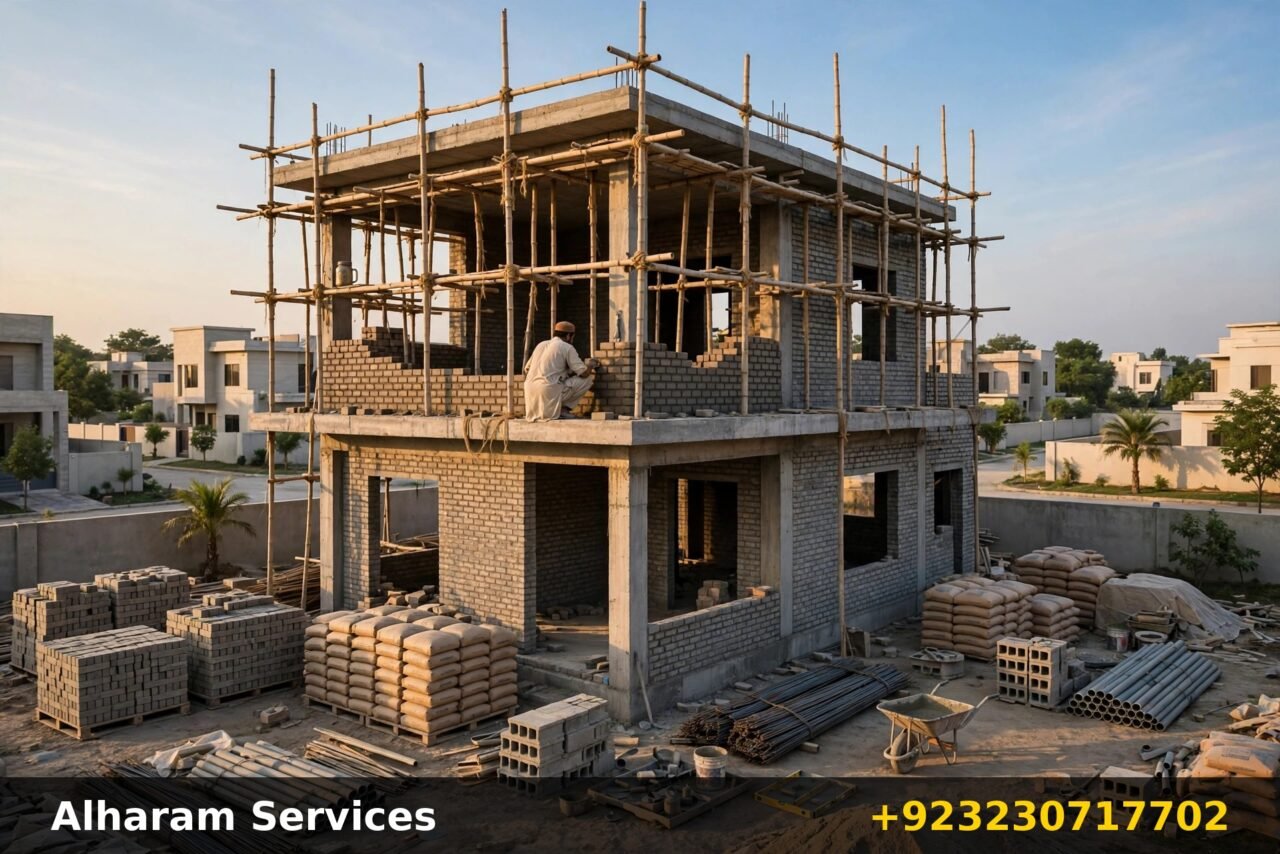

Building your own house is the biggest investment most families in Multan ever make, and the first question everyone asks is the same: how much will it cost? The honest answer is that the house construction cost in Multan is not one fixed number. It moves with your plot size, the quality of materials you choose, the design of the house, labour rates, and a handful of costs that first-time builders never see coming. This 2026 guide walks through every factor that shapes the final bill, stage by stage, so you can plan your budget with open eyes instead of learning about costs halfway through construction.
What Decides the House Construction Cost in Multan
No two houses in Multan cost the same to build, even on the same street. Before you collect a single quotation, it helps to understand the five factors that decide most of the budget. First is the covered area: a double-unit house with a basement costs far more than a single-storey house on the same plot, because every extra square foot adds structure, finishing, wiring and plumbing. Second is material quality. Awwal-grade bricks, 60-grade steel and branded cement cost more up front but reduce plaster, cracking and long-term repair work. Third is the design itself. Wide spans, double-height lounges, basements and elaborate front elevations need more steel, more concrete and more skilled labour. Fourth is the finishing level: the gap between standard local fittings and imported fittings is often larger than the gap between two grey structures. And fifth is who builds it: a turnkey contract with one accountable company prices differently from managing daily-wage labour yourself, and the cheaper-looking option is not always the cheaper one when time and wastage are counted.
Location inside Multan matters too. Plots in DHA Multan, Citi Housing, Buch Villas and Royal Orchard usually come with society bylaws, approved drawings and inspection steps that add small fees but protect you from disputes later. Older areas along Bosan Road, Gulgasht and Model City may need extra work on old sewerage lines, boundary walls or soil preparation. In MDA Officers Colony and WAPDA Town, most plots are regular in shape, which keeps foundation work simpler. Whatever the area, get your soil and plot level checked before you finalise the design — a low-lying plot that needs filling can quietly add a noticeable share to the foundation cost.
Plot Size and Covered Area: 5 Marla, 7 Marla, 10 Marla and 1 Kanal
Plot size sets the scale of everything else. A 5 marla house in Multan is the most common family project: one covered floor usually means two to three bedrooms, a lounge, a kitchen and a drawing room, and many families later add a first floor. A 7 marla plot gives breathing room for a bigger lounge and a separate guest room. A 10 marla house allows a proper double unit with a separate portion, and a 1 kanal house is a full family home with a lawn, a wide porch and often a basement.
The key point is that construction cost follows covered area, not plot size. A 5 marla plot with two full floors and a mumty has far more covered area than a 10 marla plot with a single floor and a big lawn, and it will cost more to build even though the plot is smaller. When you compare quotations, always compare them per square foot of covered area and check exactly what is included in that covered area — porch, mumty, boundary wall and basement are sometimes counted and sometimes left out, and that single difference can make two quotations look far apart when they are actually close.
Think about your family’s next ten years, not just today. Building a second floor later costs more per square foot than building it now, because the contractor has to work around a finished, occupied house. If the budget is tight, it is usually smarter to finish one good floor completely — with proper wiring, plumbing and paint — than to stretch a grey structure across two floors and leave both unfinished.
Grey Structure: The First Big Chunk
The grey structure — foundation, walls, roof slab, plaster and the basic shell of the house — is usually the single largest stage of the build, taking up more than half of the total budget in most Multan projects. It is also the stage where quality matters most, because mistakes here are hidden behind plaster and paint and only show up years later as cracks, seepage or sagging.
Foundation work depends on your soil. Most Multan plots take a standard strip or raft foundation, but plots near old water channels or with filled soil may need deeper footings. Brick quality is the next decision: Awwal-grade bricks cost more per thousand but lay straighter, need less plaster and hold paint better. Steel grade and cement brand are worth specifying in writing in your contract, along with the sand source and crush quality, because these are the materials a careless contractor is most tempted to downgrade.
The roof slab deserves special attention in Multan’s summer heat. A properly cured RCC slab with correct steel placement and good waterproofing is the difference between a cool, dry house and one that leaks every monsoon. Ask your contractor how the slab will be cured and how many days it will be kept wet — this costs almost nothing extra and protects the most expensive single element of your house. Read our detailed comparison of grey structure vs complete finishing in Multan to see exactly where the grey structure ends and finishing begins.
Finishing: Where Most Budgets Stretch
Finishing is where most Multan construction budgets drift — not because of dishonesty, but because of choices. Flooring alone can vary enormously: local tiles and imported tiles sit in completely different price bands, and wooden flooring adds another layer again. Kitchen and bathroom fittings are the same story: a standard local sanitary set and an imported set can differ several times over, and the difference is rarely visible in a quotation unless the brands are written down.
Electrical work, plumbing, paint, woodwork and false ceiling each add their own share. Electrical work includes wiring, switches, sockets, DB boxes and earthing — and in a modern Multan home, provision for air conditioners, water motors, UPS wiring and CCTV points should be planned at the wiring stage, not added later by cutting into finished walls. Plumbing means UPVC or CPVC piping, water tanks, sanitary ware and proper slope in every drain; cheap pipes are the most expensive mistake in a house because replacing them means breaking tiles. Paint quality decides how your walls look after two Multan summers — good paint and proper primer cost more now and save a repaint later.
The practical way to control finishing cost is to choose your fittings before construction starts, not during it. Visit two or three sanitary and tile shops in Multan, note the brands and models you like, and write them into the contract. When every choice is made in advance, the contractor can buy in bulk, the work moves faster, and there are no mid-project surprises. Our home renovation guide for Multan shows the same principle at work in older houses, where finishing choices decide most of the final bill.
Material Choices That Move the Budget Most
Steel and cement are the two most volatile inputs in any Multan construction project. Their prices move with the market, and a quotation that is three months old may no longer hold. Before signing a contract, confirm whether your quote is “with material” (turnkey) or labour-only, and whether the contractor locks material rates or passes increases on to you. A fixed-rate turnkey contract with a reputable construction company in Multan protects you from mid-project price shocks; a labour-only contract gives you control over every purchase but leaves you exposed to every price rise.
Beyond steel and cement, the materials worth specifying in writing are brick grade, sand source, crush quality, waterproofing chemicals, and the brands of cement, paint, sanitary fittings and electrical switches. None of these are glamorous choices, and none of them show up in a photograph of the finished house — but together they decide whether your house stays solid for decades or starts needing repairs in five years. If a contractor resists writing brands into the contract, that is useful information about the contractor.
Buying in bulk at the grey-structure stage is one of the simplest savings available. Bricks, cement and steel bought together from one supplier usually cost less per unit than the same materials bought in small lots across six months, and you avoid paying for repeated transport. The catch is storage: cement must stay dry and steel must stay off damp ground, so agree on storage with your contractor before the first truck arrives.
Labour: Mistri, Helpers and Specialised Trades
Labour typically accounts for roughly a quarter to a third of the total house construction cost in Multan. The daily rate of a mistri (mason) and a helper is only part of the story — the real cost is the rate multiplied by the number of days, and the number of days depends entirely on supervision and planning. A well-supervised crew finishes a floor in weeks; an unsupervised crew stretches the same work across months, and every extra week is another week of daily wages.
Specialised trades — electricians, plumbers, tile fixers, painters and carpenters — usually charge either daily rates or per-square-foot package rates. Package rates are often better for you because the tradesman has a reason to finish, while a daily rate rewards slow work. Whatever the arrangement, agree the rate and the scope in writing before the work starts, and never pay the full amount in advance. A standard pattern is a small advance, staged payments tied to completed work, and a final payment after you have inspected the finished job.
Hiring through an established company rather than assembling a daily-wage crew usually costs slightly more per day but finishes faster with fewer mistakes, which is cheaper overall. It also gives you one person to hold accountable when the plumber blames the mason and the mason blames the electrician. For most families building their first house, that single point of accountability is worth more than the small daily saving.
Hidden Costs Most First-Time Builders Miss
Every first-time builder in Multan meets the same surprise: the bill has lines that were never in the quotation. The most common is the boundary wall, gate and porch, which many quotations leave out entirely. Then come the water tank and motor, the sewerage connection, the electricity meter and the gas connection, each with its own fee and its own waiting time. Society charges add more: drawing approval, inspection fees and security deposits in DHA Multan, Citi Housing and other housing societies are real costs that belong in your budget from day one.
Waterproofing and termite treatment are the two items builders are most tempted to skip, and the two they regret skipping most. Multan’s monsoon rain finds every weak joint, and termites find every untreated wooden door frame. Skipping them saves a small amount today and costs far more in repairs later — a seepage repair in a finished house means breaking tiles, re-plastering and repainting, all while the family is living in the house. Our seasonal home maintenance checklist for Multan explains what happens when these early steps are missed.
Finally, budget for the finishing touches that make a house liveable: curtains, fans, lights, kitchen shelves, wardrobe interiors and the first round of cleaning. None of these appear in a construction quotation, and together they add up to a noticeable sum. A simple rule is to keep a separate contingency of around one-tenth of your budget for the costs nobody predicted. If you do not need it, it becomes your furniture fund; if you do need it, you will be glad it was there.
Turnkey Contract vs Managing Labour Yourself
There are two honest ways to build a house in Multan, and the right one depends on your time, not just your money. In a turnkey contract, one company handles everything — grey structure, finishing, electrical, plumbing and woodwork — for a fixed price and a fixed timeline. You pay more per day, but you get a written BOQ (bill of quantities), a schedule, and one accountable contractor. In the self-managed route, you hire the mistri, buy the materials and supervise the work yourself. The daily rates look cheaper, but you carry every risk: price rises, material wastage, delays, and the cost of redoing work that was done wrong.
Self-managed building only saves money if you can be on site almost every day and you know enough to spot bad work before it is covered up. If you work a full-time job in Multan or live abroad and are building for your family back home, self-management usually costs more in the end — the house takes longer, material wastage is higher, and you pay for the same work twice when it has to be redone. For overseas Pakistanis building in DHA Multan or Royal Orchard, a turnkey contract with written progress reports and photographs is almost always the safer choice.
Whichever route you choose, get at least three written quotations and compare their BOQs line by line, not just the headline rate. A quotation that looks cheap because it leaves out the boundary wall, the water tank or the paint is not cheap at all. Ask every contractor the same questions: what is included, what is excluded, how are material price rises handled, and what is the payment schedule? The contractor who answers clearly in writing is usually the contractor who builds clearly too.
How to Keep Your Budget Under Control
The single most effective way to control the house construction cost in Multan is to finalise your design before construction starts. Mid-project changes are the number one budget killer: moving a wall after it is built, shifting a bathroom after the plumbing is laid, or changing the front elevation after the brickwork is done all cost far more than getting the design right on paper. Spend the time on the drawing, walk through it room by room with your family, and only then break ground.
Choose standard room sizes where you can. Custom spans need more steel, custom doors need custom woodwork, and custom windows need custom aluminium. Standard sizes are cheaper, faster and easier to repair later. Buy materials in bulk at the grey-structure stage when prices are locked with your supplier, and keep a simple written record of every payment and every delivery — a notebook on site, updated daily, prevents most disputes before they start.
Build in stages if the budget is tight. Complete the ground floor properly — structure, finishing, kitchen, bathrooms, paint — and leave the first floor as a planned future stage with the staircase and columns ready. A finished ground floor you can live in is worth far more than a two-storey grey structure you cannot. And resist the temptation to upgrade every fitting to the most expensive option: spend the extra money where it cannot be changed later — structure, waterproofing, wiring and plumbing — and keep the visible fittings standard, because a tap or a light can be upgraded any year while a foundation cannot.
Why Build With Alharam Services in Multan
Alharam Services is a Multan-based construction company offering complete house construction — from grey structure to turnkey finishing — along with interior design, aluminium and glass work, plumbing, electrical work and renovation services. One team handling structure, finishing and home services means one accountable contract and no blame-shifting between contractors when something needs fixing.
If you are planning to build in DHA Multan, Citi Housing, Buch Villas, Royal Orchard, Bosan Road, Gulgasht, Model City or MDA Officers Colony, contact Alharam Services for a free consultation and a detailed cost estimate for your plot. A proper estimate starts with your plot size and your drawings, not with a guessed number — and it is free, so there is no reason to start building without one.
Frequently Asked Questions
How much does it cost to build a 5 marla house in Multan in 2026?
There is no single fixed figure, because the cost depends on covered area, material quality, finishing level and whether the contract is turnkey or labour-only. A 5 marla single-storey house with standard finishing costs noticeably less than the same plot built as a double unit with premium fittings. The reliable way to know your number is a written BOQ prepared from your drawings — Alharam Services prepares one free after reviewing your plot and design.
What is the per-square-foot construction rate in Multan?
Rates are quoted per square foot of covered area and move with steel, cement and labour prices, so any figure you hear today should be confirmed in a written quotation. Grey structure and complete finishing are quoted separately, and the finishing rate varies far more than the grey structure rate because it depends on your choice of tiles, fittings, paint and woodwork. Always ask what is included in the per-square-foot rate before comparing two quotations.
Is it cheaper to build with a contractor or manage labour myself?
Self-managed daily-wage labour looks cheaper per day but usually takes longer and wastes more material. A turnkey contract with an experienced construction company is typically cheaper overall and far less stressful, especially if you work full-time or live abroad. The deciding factor is supervision: if you cannot be on site almost every day, hire one accountable contractor.
How long does it take to build a 5 marla house in Multan?
A single-storey 5 marla house typically takes six to nine months from foundation to finishing, assuming materials and payments flow without interruption. The grey structure usually takes the first two to three months, and finishing takes the rest. Delays most often come from design changes mid-project, late material deliveries and unpaid bills, so a clear schedule and a contingency budget are the best protection against overruns.
Should I choose a fixed-rate or cost-plus construction contract?
A fixed-rate (turnkey) contract protects you from material price increases, because the contractor carries that risk. A cost-plus contract gives you transparency on every purchase but exposes you to market swings. For most homeowners in Multan, a fixed-rate contract with a detailed BOQ is the safer choice — and whichever you choose, get the payment schedule, the material brands and the completion date in writing.
Start Your House in Multan With a Clear Budget
Building a house is a once-in-a-lifetime project for most families, and the difference between a smooth build and a stressful one is rarely money — it is planning. Finalise your design, choose your materials, get a written BOQ, and hire one accountable team. If you would like a free consultation and a detailed cost estimate for your plot in Multan, call Alharam Services at 03230717702, email alharamservices786@gmail.com, or visit our contact page. We build across DHA Multan, Citi Housing, Buch Villas, Royal Orchard, Bosan Road, Gulgasht, Model City and MDA Officers Colony — and we would be glad to help you build yours.


Leave a Reply