

What Is a False Ceiling — and Why Multan Homes Need One
Walk into a well-finished house in DHA Multan or a new home on Bosan Road and look up. The ceiling is rarely just a flat slab of concrete. In most cases there is a second, lower ceiling hanging a few inches below the real one — a false ceiling. It hides the wiring, the pipes and the rough concrete finish, and it turns a plain room into a finished, comfortable space.
A false ceiling is a secondary ceiling fitted below the structural roof or slab, held up by a light metal frame. The gap between the two ceilings is useful space: electric wires, LED light fittings, air-conditioning ducts, CCTV cables and even insulation can all run through it without a single wire showing on the walls. In a city like Multan, where summer temperatures climb high and houses are built with concrete roofs that absorb and radiate heat, that gap also works as a layer of insulation. A well-planned false ceiling can make a room feel cooler, quieter and noticeably more finished.
Homeowners in Multan usually install a false ceiling for one of four reasons: to improve the look of a room, to hide services and wiring, to manage light better, or to reduce heat. Most projects achieve all four at once. A drawing room in Gulgasht, a bedroom in Citi Housing, a kitchen in Royal Orchard or a new house in Buch Villas all benefit — but the right material and design are different for each room, and choosing badly is an expensive mistake. A ceiling that sags after one monsoon, a design that traps heat instead of reducing it, or a material that cannot survive a bathroom’s steam will cost more to fix than to do properly the first time.
This guide covers every common false ceiling type used in Multan, what each one costs in terms of the factors that drive the price, which design suits each room, how lighting works with it, and the installation process step by step — so you can brief a contractor with confidence instead of accepting whatever he suggests.
Gypsum False Ceiling: The Most Popular Choice in Multan
Gypsum board is the most common false ceiling material in Multan’s new houses, and for good reason. Gypsum boards are light, smooth, easy to cut into any shape, and they take paint beautifully. A skilled team can build a simple flat gypsum ceiling in a bedroom in a day or two, and a layered tray design with cove lighting in a drawing room in three to four days.
The board itself is a sheet of gypsum plaster sandwiched between paper liners, fixed to a galvanised steel frame that hangs from the slab with wires. Joints are taped and filled, the surface is sanded smooth, and then it is painted like a wall. The result is a seamless ceiling that looks like solid plaster — no visible joints, no grid lines.
Gypsum works best in living rooms, bedrooms, drawing rooms and dining rooms. It handles the dry heat of Multan well, and its smooth finish suits modern interiors. It is not the right choice for wet areas: gypsum board softens if it stays damp, so it should never go in a bathroom or directly above a kitchen hob where steam rises constantly. In kitchens, keep gypsum away from the cooking zone or use a moisture-resistant board there.
One practical point matters more than most people realise: the quality of the frame decides whether a gypsum ceiling stays flat. Thin, cheap channels bend over time and the board sags between supports. Ask your contractor what gauge of channel he is using and how far apart the hangers are — a ceiling hung on a proper frame with close supports will stay level for years.
POP (Plaster of Paris) Ceiling: Classic Curves and Detail
Before gypsum boards became common, POP was the standard false ceiling material in Pakistan, and it is still the best choice when the design calls for curves, cornices, medallions or detailed moulding. POP is applied as a wet plaster over a mesh or fibre base, and a craftsman can shape it by hand into arches, domes, floral patterns and layered borders that a flat board simply cannot reproduce.
POP suits traditional and luxury interiors — a formal drawing room in Model City, a main lounge in MDA Officers Colony, or a house where the owner wants a classic, ornamental look. It is also the material of choice for a decorative centre medallion around a chandelier or a heavy ceiling fan.
The trade-off is time and skill. POP work is slower than gypsum, it needs a genuinely skilled craftsman rather than a general labourer, and the finish depends entirely on the hands doing it. It is also heavier than gypsum, so the support structure must be right. But where the design needs curves and detail, nothing else matches it. For a clean, straight-lined modern ceiling, gypsum is faster and cheaper; for a traditional or ornate ceiling, POP is still the right call.
PVC False Ceiling: Practical, Waterproof and Low Maintenance
PVC panels are the workhorse of wet and utility areas. The panels are light, completely waterproof, termite-proof and easy to clean with a damp cloth. They click together in tongue-and-groove joints and come in plain white, wood-grain and marble finishes.
In Multan homes, PVC belongs in bathrooms, kitchens, laundry areas, balconies and outdoor passages — anywhere steam, splashes or rain can reach the ceiling. A bathroom ceiling in a house on Bosan Road or in Citi Housing will last for years in PVC where gypsum would stain and sag within a season or two.
PVC is also popular for rented properties and budget projects because it installs quickly and needs no painting. Its limits are honest ones: it looks less premium than gypsum or wood, it can warp if a panel is fixed too tightly against a hot roof in direct sun, and it is not the material for a formal drawing room. Use it where practicality matters more than prestige, and it will serve well.
Wooden and MDF Ceilings: Warmth for Feature Areas
A wooden ceiling changes the character of a room instantly. Timber battens, wooden planks or MDF panels with a wood finish add warmth that no white board can match. In Multan, wooden ceilings are usually used as a feature — a strip over the dining table, a panelled section in a study, or a full ceiling in a TV lounge — rather than across the whole house, because solid wood costs more and needs protection from termites and moisture.
MDF panels with a laminate or veneer finish give much of the same look at a lower cost and with less maintenance, and they are easier to cut into geometric patterns. Whichever you choose, the timber must be treated against termites, and the design should allow for Multan’s dry heat: wood expands and contracts with temperature, so proper gaps and fixing methods matter.
A wooden false ceiling pairs beautifully with warm cove lighting and with the wooden furniture common in Multan homes. It is a design choice rather than a budget choice — use it where you want the ceiling itself to be a feature, not where you need the cheapest cover for a slab.
Metal and Grid Ceilings: For Offices and Commercial Spaces
Walk into an office, a clinic or a shop on M A Jinnah Road and you will usually see a grid ceiling: square mineral-fibre or metal tiles dropped into a visible aluminium grid. The tiles lift out individually, so any wiring, air-conditioning duct or light fitting above the ceiling can be reached in seconds without cutting anything.
Grid ceilings are the right answer for commercial space — offices in Gulgasht, clinics on Bosan Road, showrooms and shops. They are less common in homes because the visible grid looks institutional, but they make sense in a home office, a basement, or a passage where access to services matters more than appearance. Mineral-fibre tiles also absorb sound, which helps in a room used for meetings or study.
False Ceiling Designs for Each Room
A ceiling design should follow the room, not the other way round. The most common mistake in Multan is copying a dramatic drawing-room design into a small bedroom, where a deep tray ceiling makes the room feel cramped.
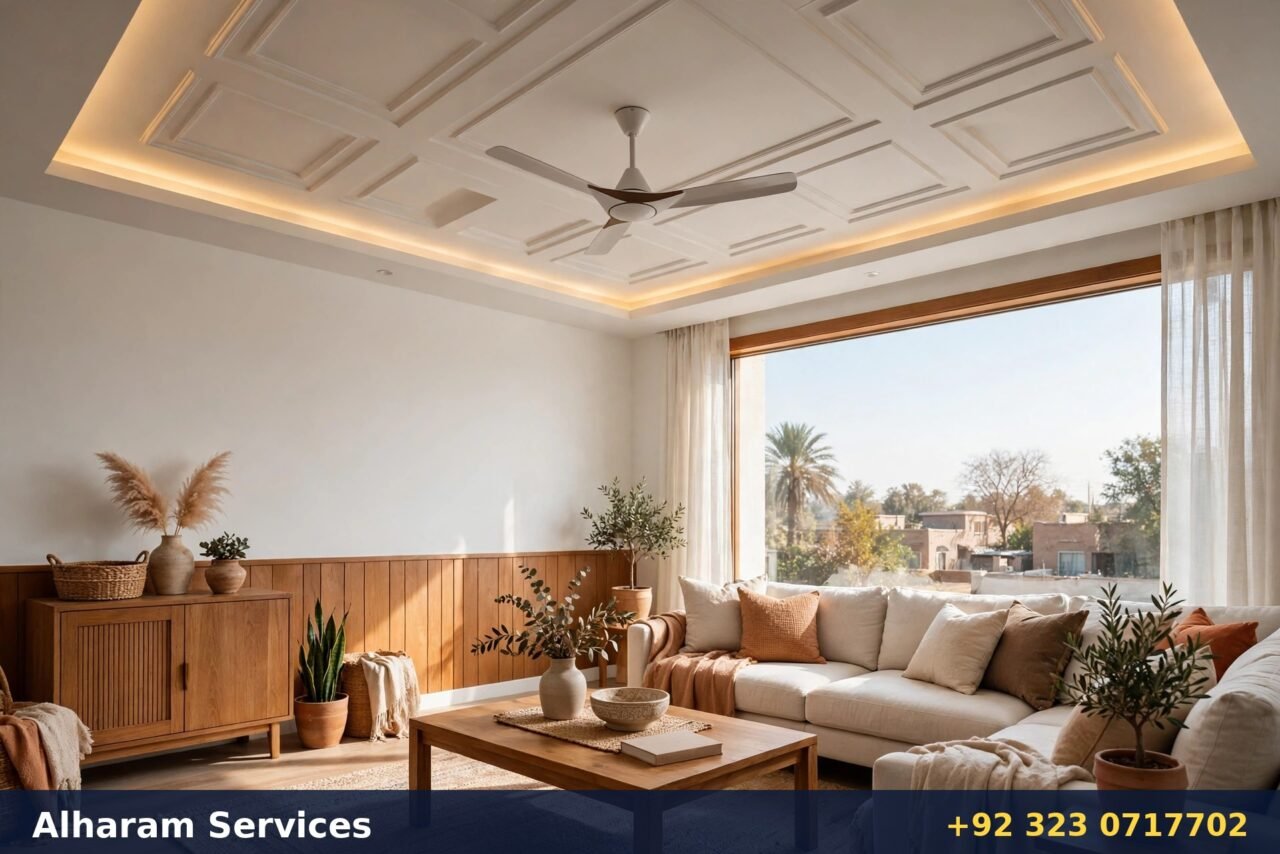
Drawing room and lounge: this is where a layered tray or coffered design earns its place. A recessed centre panel with warm cove lighting, a chandelier or a statement pendant, and a border that frames the room gives the formal feel a drawing room needs. Keep the drop shallow — four to six inches is enough — so the room keeps its height.
Bedroom: keep it simple and restful. A flat gypsum ceiling with a soft cove light around the edge, or a single shallow tray over the bed, is enough. Avoid busy patterns above the bed; you will be looking at it every night. A ceiling fan needs a solid fixing point, so tell the contractor where the fan will hang before the frame goes up.
Kitchen: use PVC or moisture-resistant board, keep the design flat and easy to wipe, and plan the lighting over the worktops rather than in the middle of the room. Recessed lights over the counter and a simple flat ceiling are far more useful than a decorative design that collects grease.
Bathroom: PVC only, with an exhaust fan vented properly. Steam is the enemy, and no amount of paint will save a gypsum board in a bathroom without ventilation.
Dining area: a wooden or MDF feature panel over the dining table, with a pendant light hanging through it, creates a defined zone in an open-plan lounge-diner — a layout increasingly common in new houses in DHA Multan and Royal Orchard.
Lighting That Works With a False Ceiling
A false ceiling is only half the project; the lighting is the other half, and the two must be planned together. The most common regret after a ceiling is finished is lighting that was added as an afterthought — too few points, wrong positions, or harsh white light in a room meant for relaxing.
Cove lighting is the signature look of a modern Multan ceiling: LED strips hidden in a recessed edge wash the ceiling with soft light. Warm white (around 3000K) suits living rooms and bedrooms; cool white works in kitchens and work areas. Recessed downlights give focused light over seating and worktops. A dimmer on the main circuit lets one room serve for both a bright family gathering and a quiet evening.
Plan the light points on paper before the frame is fixed. Mark where the sofa, bed, dining table and worktops will sit, then place lights over them — not in a neat grid that ignores the furniture. Every light, fan and fitting must be wired before the boards go up, because adding a point afterwards means cutting into a finished ceiling.
False Ceiling and Multan’s Summer Heat
Multan’s summers are long and hot, and the roof slab of a house absorbs heat all day and releases it into the rooms below at night. A false ceiling helps in two ways: the air gap between the slab and the ceiling acts as insulation, and the gap can hold an extra layer of insulation material — thermopore sheets or glass wool — for houses where the top floor gets the worst of the sun.
This matters most on the top floor of a house in areas like Gulgasht or Model City, where the roof takes direct sun all day. A false ceiling with insulation above it will not replace an air conditioner, but it will reduce the heat coming through the roof and let the room cool faster in the evening. If your top-floor rooms stay hot long after sunset, the ceiling is one of the first places to look.
Ventilation in the gap matters too. A sealed, unventilated gap can trap hot air. In rooms with an exhaust fan or air conditioning, the ceiling design should not block airflow, and recessed lights should be the LED type that runs cool — old halogen downlights add heat inside the ceiling void.
What Decides the Cost of a False Ceiling in Multan
There is no single price for a false ceiling, because the cost depends on choices you control. Anyone quoting a flat rate without asking about the room, the material and the design is guessing. The factors that actually move the price are:
Material: gypsum is the mid-range standard; PVC is usually the most economical; POP costs more where detailed handwork is involved; wood and MDF feature work costs the most. The board or panel is only part of the cost — the frame, screws, joint compound, paint and labour often add up to as much again.
Room size and ceiling height: cost is normally worked out per square foot, so a large drawing room costs proportionally more than a small bedroom. Very high ceilings add scaffolding and labour time.
Design complexity: a flat ceiling is the most economical. Every layer, curve, cove and cut-out adds labour hours. A two-layer tray with cove lighting can cost substantially more than a flat ceiling of the same area, because of both the extra material and the extra days of work.
Lighting and fittings: LED strips, downlights, chandeliers, fan hooks and dimmers are usually priced separately from the ceiling itself. Get them itemised in the quotation so you can compare like with like.
Access and condition of the existing ceiling: a straight, sound slab is quick to work on. A ceiling that needs old paint removed, cracks repaired or a leaking roof fixed first will cost more — and the roof leak must be fixed before any ceiling goes up, or the new ceiling will be ruined at the first rain.
Always get the quotation in writing, itemised by material, area, design and lighting, from at least two contractors. A quotation that lists only a total figure tells you nothing about what you are actually buying.
Installation Process, Step by Step
Knowing the process helps you supervise it. A proper false ceiling installation in a Multan home follows these steps, and skipping any of them shows up later as a sag, a crack or a stain.
Step 1 — Measure and mark. The contractor measures the room, agrees the ceiling height with you, and marks level lines on the walls. The height is your decision: a drop of four to six inches suits most rooms; more than that in a low room makes it feel cramped.
Step 2 — Fix the frame. Galvanised steel channels are fixed to the walls and hung from the slab with wires at regular intervals. This is the step that decides whether the ceiling stays flat — check that the hangers are close together and the frame is level before any board goes on.
Step 3 — Run the services. All wiring for lights and fans, and any ducts or cables, are run through the gap now, while everything is still open and reachable.
Step 4 — Fix the boards or panels. Gypsum boards are screwed to the frame; PVC panels click into place; POP is applied over its base. Cut-outs for lights and fans are made at this stage.
Step 5 — Finish the joints. Gypsum joints are taped, filled and sanded until invisible. This is skilled work — a rushed joint will show as a line through the paint within months.
Step 6 — Paint and fit lights. The ceiling is primed and painted, then the lights, fans and fittings are installed and tested. Only then is the job finished — insist on seeing every light working before the final payment.
A single room typically takes two to four days from frame to paint; a full house takes a week or more depending on the number of rooms and the complexity of the designs.
Common Mistakes to Avoid
Most false ceiling problems in Multan come from a short list of avoidable mistakes. The first is choosing the wrong material for the room — gypsum in a bathroom, or PVC in a formal drawing room. The second is hiring on price alone: the cheapest quotation usually means the thinnest frame, the fewest hangers and the fastest joint work, and the ceiling pays for it within a year.
The third is ignoring the roof. A false ceiling hides a leaking roof; it does not fix it. If there is any damp patch or stain on the slab, find and fix the leak first, or the new ceiling will stain and sag at the first monsoon. The fourth is forgetting the fan: a ceiling fan needs a proper hook fixed to the slab, not screwed into a gypsum board. Tell the contractor the fan position before work starts.
Finally, do not pay in full until the ceiling is painted, the lights are tested and you have looked at the finished surface in daylight. Joints and paint flaws that are invisible under a work light show clearly in daylight.
Maintenance and Repairs
A well-installed false ceiling needs little maintenance. Dust it occasionally, repaint it when the rest of the room is painted, and keep an eye out for the two warning signs that mean action is needed: a brown stain, which means water is getting in from above, and a sag or bulge, which means the frame or a board has failed. Both should be checked promptly — a small stain is a leak caught early; a stain ignored for a season becomes a collapsed board.
Small repairs are straightforward: a damaged gypsum section can be cut out and replaced, a PVC panel can be unclipped and swapped, and a cracked joint can be refilled and repainted. The key is matching the repair to the material — and keeping a record of which material and paint were used in each room, so a repair years later is simple.
For more on keeping the whole house in good order through Multan’s seasons, see our home maintenance checklist, and if the ceiling is part of a larger update, our home renovation guide covers planning and budgeting room by room.
Frequently Asked Questions
Which false ceiling material is best for a bedroom in Multan?
Gypsum is the best all-round choice for bedrooms: smooth finish, easy to paint, handles Multan’s dry heat well, and suits both flat and tray designs with cove lighting. Keep it away from damp walls and make sure the fan has a proper slab fixing.
Can a false ceiling be installed in a bathroom?
Yes, but only in PVC or another waterproof material, with a working exhaust fan. Gypsum and POP should not be used in bathrooms because steam softens them and causes staining and sagging.
How long does a false ceiling last?
A properly installed gypsum or POP ceiling lasts many years — often the life of the room’s decoration — as long as the roof above it stays dry. PVC lasts just as long in wet areas. The frame quality and the roof condition matter more than the board brand.
Does a false ceiling really reduce heat in summer?
Yes, to a useful degree. The air gap between the slab and the ceiling slows heat transfer, and adding insulation in the gap improves it further. It will not replace cooling, but top-floor rooms in Multan feel noticeably more comfortable with a ceiling and insulation than with a bare slab.
Should I install a false ceiling before or after painting the walls?
Install the ceiling first, then paint the walls. Ceiling work creates dust and the joint compound can mark walls. Painting the ceiling and walls together at the end gives the cleanest finish.
Get a Free Quote for Your False Ceiling in Multan
If you are planning a false ceiling — one room or a whole house in DHA Multan, Citi Housing, Buch Villas, Royal Orchard, Bosan Road, Gulgasht or Model City — contact Alharam Services for a free quote. We handle design, materials, lighting and installation, and we itemise every quotation so you know exactly what you are paying for. Call us on 03230717702, email alharamservices786@gmail.com, or visit our office at M A Jinnah Rd, Gulraiz Town, MDA Officers Colony, Multan. You can also see our full range of services on our Our Services page and our interior design services in Multan.



Leave a Reply