


Glass lets light in, aluminium holds it in place — and together they decide how a house in Multan looks, how cool it stays, and how safe it feels. A well-made aluminium window slides smoothly for ten years, keeps dust and rain out during the monsoon, and cuts the heat that pours in during a 45°C summer afternoon. A badly made one rattles in the wind, leaks at the corners, and fogs up from the inside within a year. The difference is almost never the material itself — it is the profile, the glass, the fitting, and the hands that install it. This guide covers the aluminium and glass work in Multan that homeowners and shop owners actually need: the types of windows and doors, the glass options that suit Multan’s climate, what good installation looks like, and how to choose a contractor you can trust.
Alharam Services provides complete aluminium and glass work in Multan — windows, doors, shop fronts, partitions, shower enclosures and railings, from measurement to final fitting. Our team works across DHA Multan, Citi Housing, Buch Villas, Royal Orchard, Bosan Road, Gulgasht, Model City, MDA Officers Colony and Wapda Town. For a free measurement and quote, call 03230717702 or visit our contact page.
What Aluminium & Glass Work Covers
Aluminium and glass work is a single trade with many jobs. In a house it usually means windows and doors, a glass partition between rooms, a shower enclosure in the bathroom, a glass railing on the stairs or balcony, and sometimes aluminium kitchen cabinets or wardrobe shutters. In a shop or office it means the shop front — the glass wall and door that customers see first — plus office partitions, display counters, and signage panels.
The material is popular for good reasons. Aluminium does not rust, does not swell in the monsoon, and does not need painting every year the way wood does. It is light enough to carry upstairs, strong enough to hold large glass panels, and it can be powder-coated in almost any colour — white, champagne, bronze, black, or wood finish. Glass, meanwhile, brings in daylight, makes a small room feel bigger, and — when the right type is chosen — keeps heat out and noise down. Together they suit Multan’s climate far better than a wooden window that warps in the heat or a steel frame that rusts after two rainy seasons.
Aluminium Windows: Types and Which One Suits Multan Homes
The most common aluminium window in Multan is the sliding window — two or three panels that glide on a track. It is simple, cheap to maintain, and suits bedrooms and lounges because it never swings into the room. Its weakness is sealing: a sliding window can never seal as tightly as a hinged one, so in a dusty street or a room that faces a busy road, fine dust can find its way in around the brush seals. Good sliding windows use a proper aluminium track, nylon rollers, and a wool pile seal — the cheap ones use a thin track that bends and rollers that jam within a year.
Casement windows — hinged windows that open outward like a door — seal better and suit kitchens, bathrooms, and any room where dust and rain must be kept out. They cost more than sliding windows because the frame, hinges, and locking handle are heavier, but the seal is worth it in a room that faces the street. Awning windows, hinged at the top and opening outward at the bottom, are the best choice for bathrooms and kitchens: they can stay open in the rain without letting water in, and they give ventilation even during a monsoon shower.
For large openings, a fixed window — a pane that does not open at all — combined with a sliding or casement panel beside it gives the best of both: a clear view, plenty of light, and one opening section for air. In Multan, where the summer sun is strong, a large west-facing fixed window should always use tinted or reflective glass, or the room will become an oven by the afternoon. The window type matters less than the fit: a window that is measured a few millimetres too big is forced into the opening and never slides smoothly again, while one measured too small leaves gaps that dust and rainwater use every season.
Glass Types Explained: What to Choose and Why
The glass in the frame decides how the window performs. Clear float glass is the standard — cheap, bright, and fine for rooms that do not face strong sun. Tinted glass (bronze, grey, green, or blue) cuts glare and some heat, and it is the sensible choice for west- and south-facing windows in Multan. Reflective glass does the same job more strongly and gives privacy during the day: from outside it looks like a mirror, while from inside you can still see out. It is a good choice for street-facing rooms and shop fronts.
Frosted or obscure glass is used where light is wanted but privacy is needed — bathroom windows, the glass beside a main door, and partitions between rooms. Tempered (toughened) glass is four to five times stronger than ordinary glass and, if it ever breaks, shatters into small blunt pieces instead of sharp shards. It is the right choice for shop fronts, shower doors, glass railings, and any large panel at ground level where a person could walk into it. Laminated glass — two sheets bonded with a plastic layer — holds together even when cracked, which makes it the safest option for overhead glass and for homes with small children.
Double glazing — two panes with a sealed air gap between them — is the best option for heat and noise, but it is also the most expensive and is still uncommon in Multan homes. For most rooms, a single pane of the right tinted or reflective glass in a good aluminium frame gives most of the benefit at a sensible cost. One rule applies to every type: the glass should sit in a proper rubber gasket or glazing bead, not in a bed of loose putty, and the edges should never touch the metal directly — a thin setting block under the glass stops it from cracking when the frame expands in the summer heat.
Aluminium Doors: Sliding, Swing and Folding
Sliding aluminium doors are the standard choice for balconies, terraces, and the opening between a lounge and a lawn. Two or three large glass panels glide on a track and, when open, connect the room to the outside. The track must be strong enough for the weight — a heavy glass panel on a thin track sags, drags, and eventually jumps off the rail. For a wide opening, a folding door (several panels that fold back like a concertina) opens the whole wall, which suits a lounge that opens onto a courtyard or a shop that wants its full front open during the day.
Swing doors — a single glass panel in an aluminium frame on hinges — suit main entrances, offices, and shop doors. They need a good closer so the door shuts gently instead of slamming, and a proper lock: a patch fitting or a floor spring for a frameless glass door, or a multi-point lock for a framed one. A door that is used fifty times a day, like a shop entrance, needs heavier hardware than a bedroom door — this is where cheap fittings fail first, usually at the hinges or the handle, within months.
Shop Fronts and Commercial Glass Work
A shop front is the first thing a customer sees, and in Multan’s markets — from Bosan Road to Gulgasht and the plazas of DHA — a clean glass front is what makes a shop look open, modern, and trustworthy. A typical shop front is a fixed glass wall with a sliding or swing glass door, framed in powder-coated aluminium. Tempered glass is the standard here: it is strong, safe, and gives a clear view of the goods inside.
For a shop, the glass thickness matters more than in a house. A 12mm tempered panel is the usual choice for a shop front; thinner glass flexes and rattles when the door slams or a truck passes. The frame colour should match the shop’s branding — black and champagne are the most common — and the door should have a proper closer and lock, because a shop door is opened hundreds of times a day. Frameless glass fronts, where the panels are held by small patch fittings instead of a full frame, look more premium but cost more and need a very level floor and a skilled fitter. Whatever the style, the bottom track and the door closer are the parts that take the wear, so they are worth spending on.
Glass Partitions and Office Work
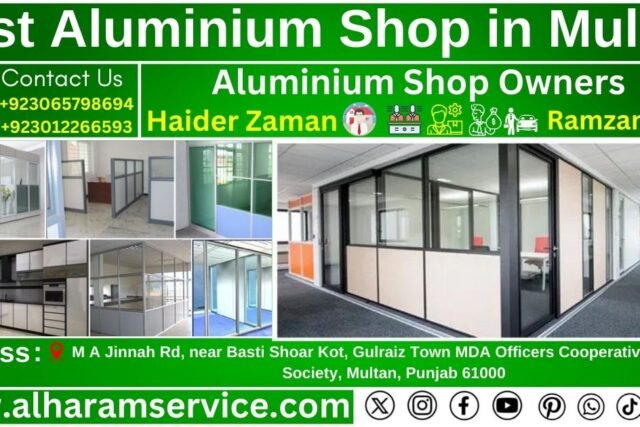
Glass partitions divide a space without closing it off — an office cabin that still feels part of the room, a lounge separated from a dining area, a shop counter that keeps the display visible. A partition is usually a fixed glass panel in a slim aluminium frame, sometimes with a sliding or swing door built in. Frosted film or a frosted band across the middle gives privacy at eye level while keeping the light.
In offices, a partition with a door and a lock creates a manager’s cabin in a day, with no brickwork, no plaster, and no drying time. In homes, a glass partition between the lounge and the drawing room keeps the air conditioning in one room while keeping the view open. The key detail is the frame: it must be fixed to the floor, ceiling, and walls with proper anchors, not just siliconed in place, or the panel will wobble every time the door closes. A partition that is fixed properly feels like a wall; one that is not feels like a loose sheet of glass.
Shower Enclosures, Railings and Stair Glass
A glass shower enclosure turns a wet bathroom corner into a dry one. A single fixed panel, a sliding door, or a hinged door in tempered glass keeps the water inside the shower area, and the bathroom floor stays dry. The glass must be tempered — ordinary glass in a shower is a safety risk — and the seals at the bottom and sides must be proper rubber profiles, not a bead of silicon that peels off in a few months.
Glass railings on stairs and balconies are now common in new Multan houses, and they look light and modern compared with a steel grill. The glass is always tempered and laminated, held by a channel at the base or by clamps. The base channel is the critical part: it must be fixed to the slab with proper bolts, and the glass must sit on setting blocks inside the channel, never directly on concrete. A railing that moves when you lean on it was not fixed properly, and it should be corrected before the house is occupied — not after.
Aluminium vs UPVC vs Wood: A Fair Comparison
Homeowners often ask whether aluminium, UPVC, or wood is the best frame material. Each has a place. Aluminium is the strongest of the three for large openings, lasts decades without rusting or rotting, and needs almost no maintenance — a wipe with a damp cloth is enough. It conducts heat more than UPVC, which is why a good frame with a proper seal and the right glass matters more than the material alone.
UPVC frames insulate better than aluminium and are popular in colder countries, but in Multan’s summer heat, cheap UPVC can soften and warp, and the colour can fade in strong sun. Good-quality UPVC works well, but it costs more than aluminium for the same opening. Wood looks warm and traditional, and a solid wooden window can last a lifetime — but it needs regular painting and varnishing, it swells in the monsoon, and termites are a real risk in Multan. For most Multan homes, aluminium gives the best balance of strength, life, looks, and cost, which is why it is the standard choice for windows, doors, and shop fronts across the city.
What Good Installation Looks Like
The best profile and glass in the world are wasted by a bad installation, and most window problems in Multan are installation problems, not material problems. Good installation has a few visible signs you can check yourself.
First, measurement: the frame should fit the opening with a small, even gap all round — about 5 to 10 millimetres — filled with foam or a proper sealant, not with loose packing and cement. Second, fixing: the frame should be anchored to the wall with screws through proper plugs, at least three fixings per side on a normal window, and the screw heads should be covered. Third, levelling: a sliding panel should glide with one finger and stop where you leave it; if it rolls back on its own, the frame is not level. Fourth, sealing: the joint between the frame and the wall should be sealed with a weatherproof silicon, inside and outside, with no gaps where rain can enter. Fifth, hardware: the handles, locks, rollers, and hinges should be the brand and quality that was agreed — not a cheaper substitute fitted after the quote was accepted.
Ask the installer to show you these points before you pay the final amount. A professional will not mind; a contractor who rushes you to pay before you have checked the work is telling you something. If you are building a new house, read our house construction cost guide for Multan first — windows and doors are one of the finishing items where the budget is most often underestimated.
Cost Factors: What Decides the Price
There is no single price for aluminium and glass work, because the cost depends on five things: the aluminium profile (its thickness and brand), the glass type and thickness, the size of the opening, the hardware (rollers, locks, handles, closers), and the finish (powder coating colour and quality). A small bathroom window and a full shop front are priced the same way — per square foot of the opening — but the rate changes with every one of those five factors.
A thicker profile costs more but holds a larger glass panel safely and does not bend over time. Tempered glass costs more than ordinary glass, and 12mm glass costs more than 5mm, but both are worth it where safety and strength matter. Imported rollers and locks cost more than local ones and last years longer — on a door that is used every day, that difference pays for itself quickly. Powder coating in a standard colour costs less than a special wood-finish colour. The honest way to compare quotes is to ask every contractor for the same specification in writing: profile brand and thickness, glass type and thickness, hardware brand, and coating — and then compare the totals. A quote that is much cheaper than the others has almost always left one of those five things out.
Maintenance and Cleaning: Keeping Glass and Aluminium New
Aluminium and glass need very little maintenance, which is part of their appeal — but a little care keeps them looking new for years. Clean the glass with water and a soft cloth, or a mild glass cleaner; never use a blade, a scouring pad, or a harsh chemical, which will scratch the coating on tinted and reflective glass. Clean the aluminium frame with a damp cloth and mild soap, and wipe the track of a sliding window or door every few weeks — dust and grit in the track are the main reason a sliding panel becomes hard to move.
Once a year, check the silicon seal around the frame: if it has cracked or pulled away, have it replaced before the monsoon. Check the screws on handles and hinges, and put a drop of oil on a stiff lock or hinge. If a sliding panel starts to drag, the rollers may need adjusting — a small screw at the bottom of the panel raises or lowers it, and a five-minute adjustment usually fixes it. If a glass panel ever cracks, do not leave it: a cracked tempered panel can shatter without warning, and a cracked ordinary panel is a safety risk. Call a professional to replace it the same week.
How to Choose an Aluminium & Glass Contractor in Multan
Choosing the right contractor matters more than choosing the right profile, because the contractor chooses the profile, measures the opening, and does the fitting. Start by seeing their finished work: a shop they fitted a year ago, a house whose windows they installed last summer. Look at the corners of the frames, the silicon joints, and whether the sliding panels still move smoothly — a year-old installation tells you more than a showroom sample.
Ask for a written quote that names the profile, the glass, the hardware, and the coating. Ask who will do the measurement — it should be the person who will do the fitting, not a salesman. Ask how long the work will take, and what happens if a panel arrives scratched or the wrong size: a professional replaces it at their own cost. And check that the contractor has a real workshop and a real address in Multan — a team that works from a proper shop, like Alharam Services on M A Jinnah Road, can be found again if anything needs fixing after the work is done. A contractor with no address is a contractor you cannot call back.
If your project is part of a bigger renovation — new windows, a new kitchen, a fresh ceiling — plan the order of work first. Our home renovation guide for Multan explains the sequence, and our false ceiling guide and kitchen design guide cover the other finishing items that usually go in with new windows and doors.
Frequently Asked Questions
Which glass is best for windows in Multan?
For most rooms, tinted or reflective glass in a good aluminium frame is the best balance — it cuts glare and heat from the strong summer sun while keeping the room bright. Use tempered glass for large panels, shop fronts, shower doors, and railings, and frosted glass for bathroom windows where privacy matters.
How long do aluminium windows last?
A properly made and fitted aluminium window lasts 20 years or more with almost no maintenance — aluminium does not rust, rot, or swell. The parts that wear first are the rollers, seals, and handles, which can be replaced individually without changing the whole window.
Is aluminium work expensive in Multan?
The cost depends on the profile, the glass type and thickness, the size of the opening, the hardware, and the finish. Get a written quote that names all five, and compare quotes on the same specification — a much cheaper quote has usually left something out.
Can a sliding window be repaired, or must it be replaced?
Most sliding windows can be repaired: worn rollers, a bent track, a broken lock, or a perished seal can all be replaced without changing the frame or the glass. Only a bent or corroded frame needs a full replacement.
Do you provide measurement and fitting across Multan?
Yes. Alharam Services provides free measurement and quotation for aluminium and glass work across DHA Multan, Citi Housing, Buch Villas, Royal Orchard, Bosan Road, Gulgasht, Model City, MDA Officers Colony and Wapda Town. Call 03230717702 to book a visit.
Related Articles
Alharam Services — Real Estate, Construction, Interior and Home Services in Multan. Aluminium windows, glass doors, shop fronts, partitions and railings, measured and fitted by our own team. Call 03230717702 for a free quote, or visit us on M A Jinnah Road, Multan.

Leave a Reply