
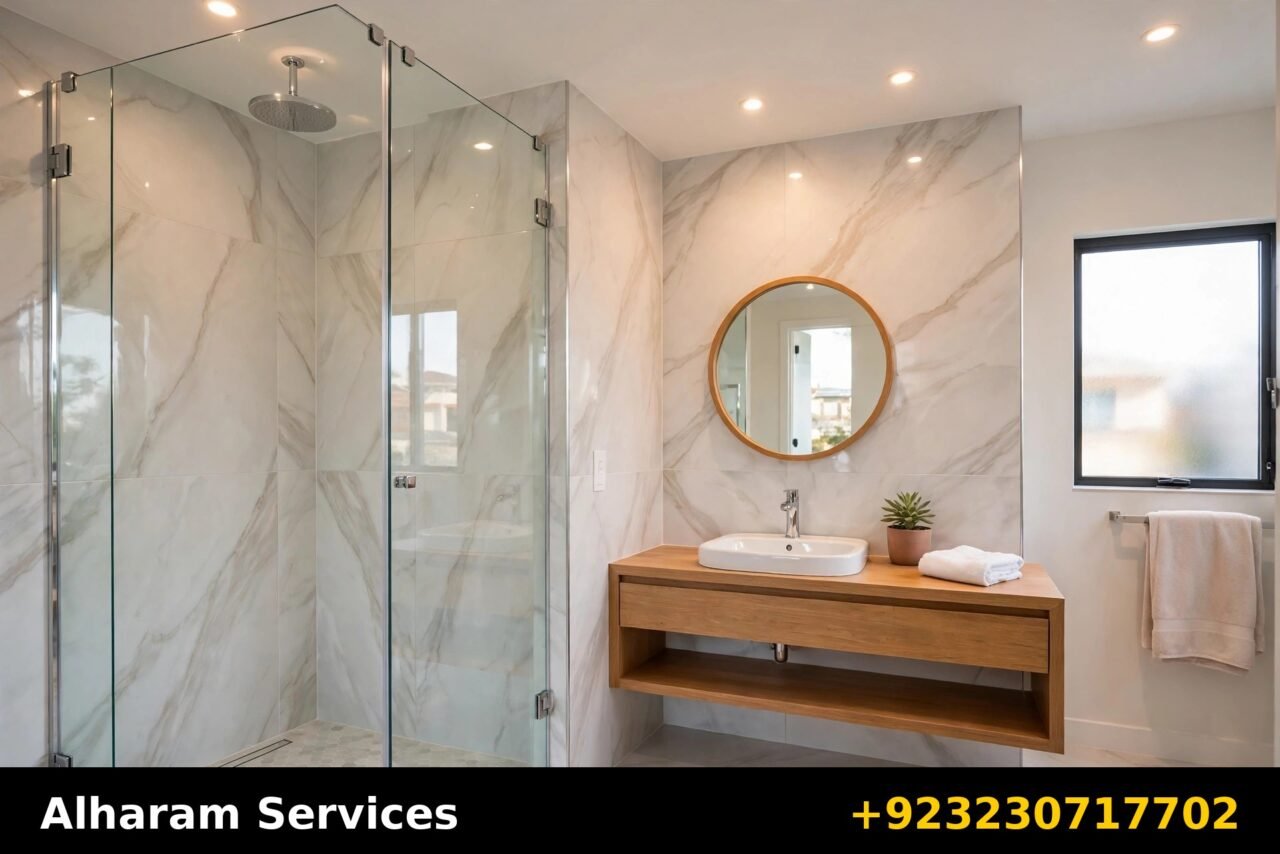

A bathroom renovation in Multan is one of the smartest upgrades you can make to your home. A bathroom is used every single day by every member of the family, yet it is the room most homeowners in Multan leave untouched for twenty years or more — until the tiles crack, the taps leak, seepage stains the wall outside, or the fittings simply look tired. This guide covers everything a bathroom renovation in Multan actually involves: how to plan the layout, what tiles and fittings suit Multan’s hot summers and hard water, why waterproofing matters more than any visible finish, what drives the cost, and how to choose a contractor who finishes the job properly.
Alharam Services provides complete bathroom renovation services in Multan — from a simple fittings upgrade to a full strip-and-rebuild of the bathroom. Our team works across DHA Multan, Citi Housing, Buch Villas, Royal Orchard, Bosan Road, Gulgasht, Model City, MDA Officers Colony and Wapda Town. For a free quote, call 03230717702 or visit our contact page.
Why Renovate Your Bathroom Now?
Most bathrooms in Multan are renovated for one of four reasons, and knowing yours decides how much work is really needed.
Leaks and seepage. This is the most common reason, and the most urgent. A damp patch on the wall outside the bathroom, paint bubbling near the floor, or a stain on the ceiling below an upstairs bathroom almost always means a leaking concealed pipe or a failed waterproofing layer. Repainting hides it for a few weeks; the dampness always comes back. A proper renovation fixes the cause — the pipe joints and the waterproofing — not just the stain.
Worn-out fittings. Taps that drip, a mixer that gives only hot or only cold water, a cistern that keeps running, a shower head choked by scale — Multan’s hard water wears fittings out faster than most homeowners expect. When three or four fittings fail at once, replacing them one by one costs more in plumber visits than a planned renovation.
A bathroom that no longer fits the family. A house built fifteen years ago for a young couple now has teenagers, elderly parents, or a joint family. The bathroom needs a bigger shower area, a proper vanity with storage, a western commode instead of a squat toilet, or grab rails for an elderly parent. Renovation is the moment to fix the layout, not just the surfaces.
Raising the value of the house. In DHA Multan, Citi Housing and Royal Orchard, buyers judge a house by its kitchens and bathrooms. A clean, modern bathroom with good tiles and branded fittings is one of the first things a buyer notices — and one of the cheapest rooms to bring up to standard compared with a full house renovation. If you are thinking of selling in the next year or two, the bathroom is where the money shows.
Bathroom Renovation Cost Factors in Multan
There is no single price for a bathroom renovation, because no two bathrooms are the same. What you pay depends on a handful of clear factors, and understanding them helps you get honest quotes and avoid surprises halfway through the work.
Size of the bathroom. A small 5 by 7 foot bathroom needs fewer tiles, less plumbing and less labour than a large master bathroom. Size is the single biggest driver of material quantity — tiles, waterproofing, paint and fittings all scale with area.
How much is stripped out. A cosmetic renovation — new fittings, new paint, a new vanity — costs far less than a full renovation where old tiles are broken off, concealed pipes are replaced, the floor is re-sloped and waterproofing is redone. The full job costs more, but it is the only option when there is seepage or the old plumbing is failing.
Tile and sanitary choices. Local Pakistani tiles and imported tiles sit in very different price bands, and the same is true of sanitary ware: a standard local commode and basin cost a fraction of imported branded sets. The fitting quality matters more than the brand name — a well-made local fitting installed properly outlasts an expensive imported one fitted badly.
Plumbing and drainage work. Moving a commode, shifting a drain point or adding a new water line means breaking the floor and relaying pipes. Keeping the existing layout — commode, basin and shower in the same places — keeps this cost low. Our plumbing services in Multan team always advises keeping the layout unless there is a strong reason to move it.
Labour and finishing. Skilled tile fixing, proper waterproofing and neat fitting installation take time. The cheapest quote is rarely the cheapest job: badly laid tiles crack, poorly sealed joints leak, and the repair costs more than the saving. Always ask a contractor what is included — demolition, debris removal, waterproofing, fittings, and final cleaning — before comparing quotes. For a realistic sense of how renovation budgets work across the whole house, read our home renovation guide for Multan.
Layouts That Work in Multan Homes
A good bathroom layout puts the three zones — wet, dry and storage — in the right order. The shower is the wet zone, the basin and vanity are the dry zone, and the commode sits between them. Water should flow away from the dry zone, not towards it.
Small bathrooms (5 x 7 ft and under). Most older houses in Gulgasht, Model City and the inner city have small bathrooms. Here the rules are simple: a corner basin instead of a wide vanity, a wall-hung commode to free floor space, a shower area marked by a glass partition rather than a full wall, and light-coloured large tiles that make the room feel bigger. Avoid a bathtub in a small bathroom — it eats a third of the floor and is rarely used in Multan’s climate.
Medium bathrooms (7 x 10 ft). This is the standard size in DHA Multan, Citi Housing and Buch Villas. A medium bathroom takes a proper vanity with storage, a separate shower area with a glass screen, and a western commode with comfortable clearance. If there is a window, keep it — natural light and ventilation matter more in a bathroom than in any other room.
Large and master bathrooms. A large bathroom can take a double vanity, a walk-in shower, and a separate WC area. The mistake to avoid is filling the space with fixtures: empty floor space is what makes a large bathroom feel luxurious. Keep the layout open, and spend the budget on better tiles and fittings rather than more of them.
Attached vs common bathrooms. An attached bathroom serves one bedroom and can be designed around its users — a couple’s bathroom needs a double vanity; a child’s bathroom needs a lower basin and non-slip floor. A common bathroom serves the whole family and guests, so durability and easy cleaning matter more than style. Plan each bathroom for who actually uses it.
Tiles and Flooring: What Suits Multan’s Climate
Tiles are the surface you see and the surface water touches every day, so the choice matters more than most people think. Multan’s summers cross 45°C, winters are mild, and the water is hard — all three affect tile performance.
Floor tiles. Choose anti-slip, matte-finish floor tiles. Glossy floor tiles look elegant in a showroom and become dangerous when wet — a real risk for children and elderly parents. Large-format tiles (24 x 24 inches) mean fewer grout lines, and fewer grout lines mean fewer places for water and dirt to collect. Dark floor tiles hide stains but show water marks; light tiles show stains but look cleaner. A mid-tone, textured tile is the practical middle ground.
Wall tiles. Full-height wall tiling — floor to ceiling — is the standard that lasts in Multan. Half-height tiling leaves the upper wall exposed to steam and splashes, and that painted wall peels within a year or two. Large-format wall tiles with minimal grout are easier to clean and look more modern. A single accent wall — behind the basin or inside the shower — adds style without the cost of designer tiles everywhere.
Marble vs ceramic vs porcelain. Ceramic tiles are the most common and most affordable choice in Multan, and a good-quality ceramic tile performs well for years. Porcelain tiles are denser, harder and more water-resistant, which makes them the better choice for the shower floor and any area that stays wet. Marble looks premium but needs sealing and stains easily from soap, shampoo and hard water — beautiful in a low-use guest bathroom, high-maintenance in a family bathroom.
Grout and sealing. Grout is the weak point of every tiled bathroom. Cheap grout cracks and lets water behind the tiles. Ask for epoxy or high-quality water-resistant grout in the shower area at minimum, and seal the corners where wall meets floor. This small detail is what separates a bathroom that lasts ten years from one that leaks in two. For the rest of the house, our paint services guide for Multan covers moisture-resistant finishes for damp-prone walls.
Sanitary Fittings and Fixtures
Fittings are the parts of the bathroom you touch every day, and in Multan’s hard water they are the parts that fail first. Buy for quality and serviceability, not just appearance.
Commode. A wall-hung commode is easier to clean under and looks modern, but it needs a concealed cistern frame fixed properly into the wall — a job for an experienced installer. A floor-mounted commode is simpler, cheaper to install and easier to repair. Either way, choose a model whose spare parts — flush valve, seat cover, inlet valve — are available in Multan’s sanitary market. An imported model with no local spares becomes useless after one small failure.
Basin and vanity. A counter-top basin on a wooden or stone vanity is the current standard in Multan’s new houses, and it gives you storage underneath for cleaning supplies and toiletries. A wall-hung basin suits small bathrooms. Whatever you choose, check the height: a basin fixed too high or too low is uncomfortable for years. Standard basin height is around 32 to 34 inches from the floor.
Taps, mixers and shower. A single-lever mixer is easier to use than separate hot and cold taps, and it wastes less water while you find the right temperature. A rain shower head feels luxurious but needs good water pressure — in areas of Multan with low pressure, a standard shower head with a hand shower works better. Buy taps with ceramic disc cartridges: they last far longer than rubber-washer taps in hard water, and they stop dripping.
Accessories. Towel rails, a mirror cabinet, a soap dish, a toilet-paper holder and robe hooks are small items, but a bathroom without them feels unfinished. Fit them during the renovation, not after — drilling into new tiles later risks cracking them. Choose stainless steel or brass accessories; chrome-plated plastic peels within a year in a humid bathroom.
Waterproofing: The Step You Cannot Skip
Waterproofing is the most important part of a bathroom renovation and the easiest to skip — because once the tiles are on, nobody can see whether it was done. Every bathroom renovation in Multan should include it, without exception.
A proper waterproofing job has three parts. First, the floor and the lower walls are coated with a waterproof membrane before any tile is laid. Second, the membrane runs up the walls — at least a foot high around the whole bathroom, and full height inside the shower area. Third, all pipe entries, drain openings and corners are sealed with extra care, because corners and joints are where water finds its way through.
The test is simple and every homeowner should insist on it: after the membrane is applied and before tiling begins, the bathroom floor is filled with a few inches of water and left for 24 hours. If the water level drops or damp appears on the ceiling below, there is a leak to fix while it is still cheap to fix. A contractor who refuses this test is a contractor to avoid. Our plumbing guide for Multan explains how seepage is traced and why repainting a damp wall never works.
Waterproofing also protects the rest of the house. A bathroom leak does not stay in the bathroom — it travels into the adjoining bedroom wall, down into the ground-floor ceiling, and into the structure itself. The cost of proper waterproofing during renovation is a small fraction of the cost of repairing a seepage-damaged wall, ceiling and paintwork a year later.
Plumbing and Drainage During Renovation
A renovation is the only time the concealed plumbing is accessible, so it is the time to fix it properly. Old galvanised iron pipes corrode from the inside; in many older Multan houses they are already half-blocked with rust and scale. Replacing them with PPR or UPVC pipes during renovation is cheap compared with breaking new tiles to reach them later.
Three plumbing checks belong in every renovation. First, pressure-test every concealed joint before the tiles go on — a ten-minute test that catches a loose joint while it is still easy to fix. Second, check the floor slope: the floor must fall gently towards the drain, so water never stands in a corner. Third, make sure the drain has a proper trap and vent, so smells do not come back up into the bathroom. A bathroom that smells is almost always a drainage problem, not a cleaning problem.
If your house has low water pressure, renovation is also the moment to address it — a larger-diameter supply pipe, a properly sized motor, or a pressure pump fitted correctly. Do not fit a bigger motor without checking the pipes first: a strong motor on old, narrow pipes just finds the weakest joint and makes it leak.
Lighting, Ventilation and False Ceiling
A bathroom needs bright, even light and constant air movement. Multan’s humidity makes ventilation a health issue, not a comfort issue — a bathroom without airflow grows mould on the ceiling and grout within months.
Ventilation. A window is the best ventilation, and a bathroom with a window should keep it. If there is no window, fit an exhaust fan that vents outside the house, not into the false ceiling void. The fan should run for a few minutes after a shower — a simple timer switch handles this automatically. Never block the bathroom vent to keep out dust; the mould that follows costs far more than the dust.
Lighting. Bright white LED downlights over the mirror and shower, with a warmer light over the vanity, give the best result. A single bulb in the centre of the ceiling leaves the mirror in shadow — the one place you need light most. All bathroom fittings should be rated for wet areas, and switches should sit outside the bathroom or well away from water.
False ceiling. A PVC or gypsum false ceiling hides pipes and wiring and gives the bathroom a finished look, but it must be the moisture-resistant type, and it must leave access to the water tank valve and any concealed cistern. A sealed ceiling over a leaking pipe hides the leak until the ceiling itself collapses. Our false ceiling guide for Multan covers materials and moisture-resistant options in detail.
Storage, Vanity and Mirror Design
A bathroom without storage ends up with bottles and cleaning supplies piled on the floor and the window sill. Plan storage during the renovation, when it is cheap to build in.
A vanity with drawers holds far more than a vanity with doors, and drawers keep small items visible instead of lost at the back of a cupboard. A mirror cabinet above the basin adds storage without taking floor space and keeps medicines and toiletries out of children’s reach. A recessed niche inside the shower wall — a small tiled shelf built into the wall — holds shampoo and soap without a rusting metal rack.
Use moisture-resistant board for any wooden vanity, and keep the bottom of the vanity a few inches off the floor or fully sealed. A wooden vanity sitting directly on a wet bathroom floor swells and rots from the bottom up. Wall-hung vanities avoid the problem entirely and make the floor easier to clean.
Choosing a Bathroom Renovation Contractor in Multan
The contractor matters more than any single material choice. A good contractor sequences the work correctly — demolition, plumbing, waterproofing, tiling, fittings, painting — and does not start the next step until the previous one is tested. A bad contractor tiles over untested pipes and unsealed walls, and the homeowner pays for it a year later.
Before hiring, ask for three things: photos of two or three completed bathrooms in Multan, a written quote that lists demolition, plumbing, waterproofing, tiles, fittings and cleaning separately, and a clear timeline with a start and finish date. Visit one completed bathroom if you can — tiles, grout lines and fitting alignment tell you more than any brochure.
Agree on who supplies what before work starts. The usual arrangement in Multan is that the homeowner buys the tiles and sanitary ware and the contractor supplies cement, sand, pipes, waterproofing chemicals and labour — but either arrangement works if it is written down. What causes arguments is the arrangement nobody wrote down: who pays for the extra cement, who buys the grout, who removes the debris.
How Long Does a Bathroom Renovation Take?
A full bathroom renovation in Multan usually takes two to three weeks, and the stages cannot be rushed. Demolition takes one to two days. Plumbing and drainage take two to three days, including the pressure test. Waterproofing needs a day to apply and a day to cure, plus the 24-hour water test. Tiling takes four to six days for a standard bathroom, then the grout needs a day to set. Fittings, false ceiling, painting and final cleaning take another three to four days.
The stage homeowners most often try to rush is the curing time — tiles laid on uncured waterproofing, grout washed before it sets, paint applied to a damp wall. Every rushed stage shows up later as a crack, a leak or peeling paint. A contractor who promises a full bathroom in five days is either skipping stages or planning to come back to fix them.
Plan for the bathroom to be out of use for the whole period. In a house with one bathroom, this means arranging access to a neighbour’s or relative’s bathroom, or scheduling the work while the family is away. A second bathroom in the house makes the whole job far easier — one more reason to plan renovations around the family’s routine.
Common Mistakes to Avoid
Skipping waterproofing. The most expensive mistake, and the most common. It saves a little money now and costs many times more in seepage repair later.
Choosing glossy floor tiles. Beautiful in the showroom, dangerous when wet. Always choose anti-slip flooring in a bathroom.
Moving the plumbing without reason. Every moved drain point means breaking the floor and relaying pipes. Keep the layout unless the current layout genuinely does not work.
Buying fittings with no local spares. A beautiful imported mixer is useless when its cartridge fails and no shop in Multan stocks the part. Check spares availability before buying.
No slope towards the drain. A flat bathroom floor leaves standing water in corners. The slope is small — barely visible — but it must be there, and it must be checked before tiling.
Forgetting ventilation. A bathroom without a window or exhaust fan grows mould. Ventilation is not optional in Multan’s humidity.
Hiring on the lowest quote alone. The lowest quote usually means skipped waterproofing, cheap grout, or unskilled tile fixing. Compare what is included, not just the total.
Frequently Asked Questions
How much does a bathroom renovation cost in Multan?
There is no fixed price, because the cost depends on the bathroom’s size, how much is stripped out, the tiles and fittings you choose, and the plumbing work needed. The main cost factors are size, demolition, waterproofing, tile quality, sanitary brand, and labour. Get a written, itemised quote from a contractor after they have seen the bathroom — a quote given without a site visit is a guess, not a price.
Can I renovate a bathroom without changing the tiles?
Yes, if the tiles are sound and there is no seepage. A cosmetic renovation — new fittings, a new vanity and mirror, fresh paint on the upper walls, new accessories — can transform a bathroom at a fraction of the cost of a full renovation. But if there is dampness, cracked tiles or failing plumbing, a cosmetic job only hides the problem. Fix the cause first.
What is the best tile for a bathroom floor in Multan?
Anti-slip, matte-finish porcelain or ceramic tiles in a large format are the practical choice. They resist water, handle Multan’s hard water and heavy use, and are easy to clean. Avoid glossy floor tiles — they are slippery when wet — and avoid marble on the floor of a family bathroom, as it stains and needs regular sealing.
How do I stop seepage from my bathroom?
Seepage is fixed at the source, not at the stain. The usual causes are a leaking concealed pipe joint or failed waterproofing under the floor. A proper repair means opening the affected area, fixing the pipe or reapplying waterproofing, and then retiling. Repainting the damp wall or applying a surface sealant only hides the problem for a few weeks.
Should I choose a western commode or a squat toilet?
For most families in Multan, a western commode is the better choice: it is easier for elderly parents and children, it suits a modern bathroom layout, and it is what buyers expect in DHA, Citi Housing and similar areas. A squat toilet is easier to clean and uses less water, which is why some families keep one in a common bathroom. Many homes fit both — western in the attached bathroom, squat in the common bathroom.
Related Articles
Get a free quote for your bathroom renovation. Alharam Services renovates bathrooms across Multan — DHA Multan, Citi Housing, Buch Villas, Royal Orchard, Bosan Road, Gulgasht, Model City, MDA Officers Colony and Wapda Town. Call 03230717702, email alharamservices786@gmail.com, or visit our contact page to book a free site visit and an itemised quote. Our office is at M A Jinnah Rd, Gulraiz Town, MDA Officers Colony, Multan.


Leave a Reply